Young Futures Digital
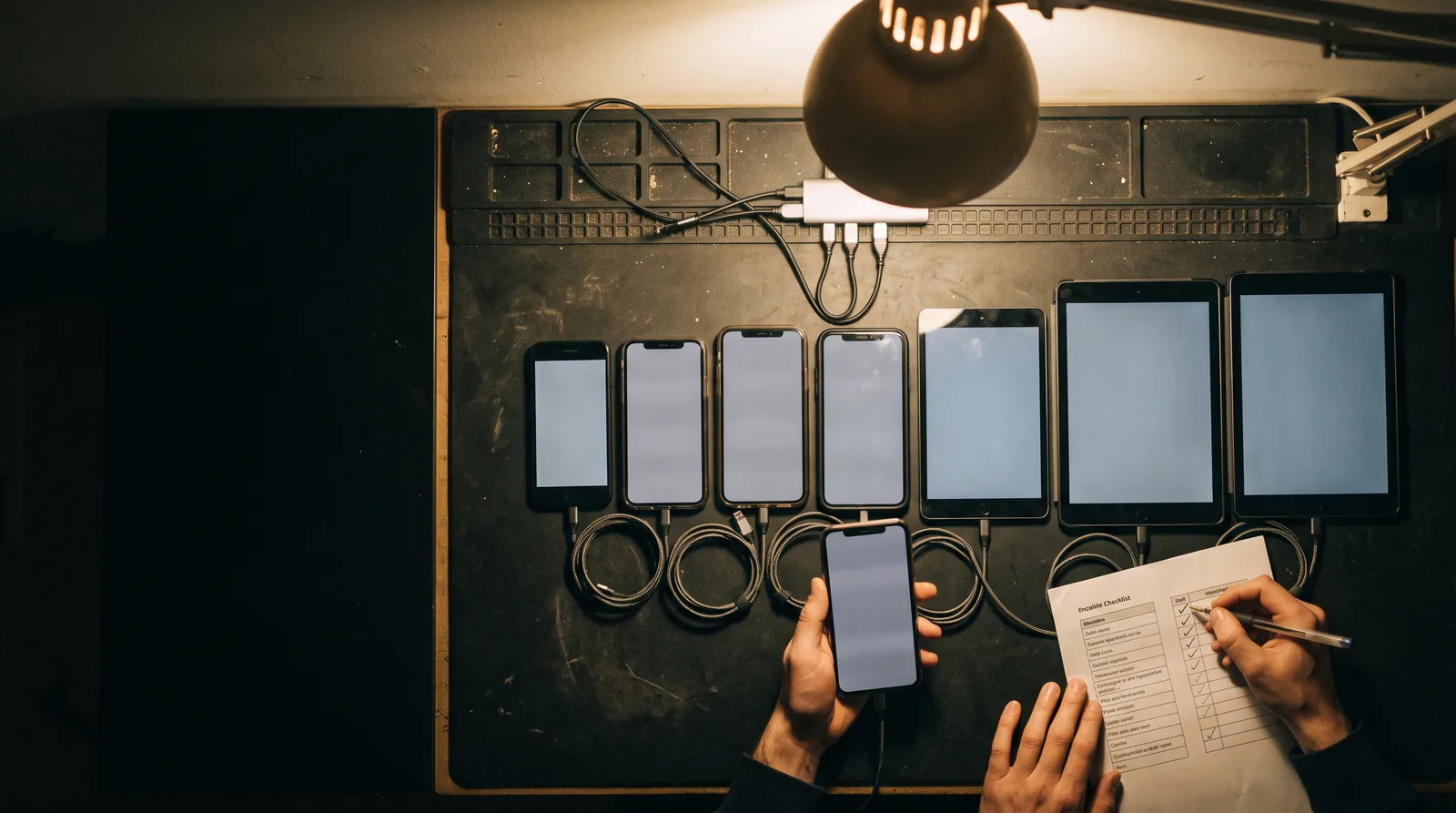
A device test bench from above: six phones and two tablets of different sizes in a row on a dark mat, each on a USB cable, with two hands checking one device against a printed checklist.
Service 04 Services / Mobile & product

Apps tested on real devices, released properly

Design and build for iOS and Android, then the part most people underestimate — structured testing on real handsets, accessibility, store listings, review submission and the release itself. We only recommend an app when a mobile website genuinely cannot do the job, and we will tell you when it can.

When an app is the right answer — and when it is not

■ 04.0 Device bench — every build checked on real handsets, not just a simulator iOS · Android · Hosting · App Store · Google Play
  • RegisteredLondon-based, registered in England and Wales
  • DeliverySenior-led — the people you brief do the work
  • DataUK GDPR and data protection by design
  • AccessibilityWCAG 2.2 AA as standard, not an extra
  • PricingA written scope before any quote
  • ContactDirect with the team, no account layer
01 The problemDiagnosis before build

Diagnosis first

Most projects that want an app need a website.

We do not quote until we understand what is actually going wrong. The first conversation is free, and it ends with a clear recommendation and a realistic figure — not a sales follow-up.

An app costs more than a website. Sometimes that is worth paying.

Two platforms, store review, a hundred handsets to account for, and a user who has to be persuaded to install it and then keep it. Worth every penny when you genuinely need the camera, offline use, notifications or real speed. Not worth a penny for content someone reads once.

The second thing people underestimate is release. An app is not finished when the last screen is built. It has to pass review, carry a store listing, hold a privacy declaration that matches what it actually collects, and be signed with certificates held in accounts your organisation controls rather than a former contractor’s. Getting that wrong is where launches slip by weeks.

So we start with the question of whether you need an app at all, then with the release path if you do. Store accounts, developer organisation verification, testing groups and a privacy declaration are set up early, not the week you hoped to launch. And your build is checked on a bench of real handsets across screen sizes and OS versions, because a simulator will not show you what a three-year-old mid-range Android does with your interface.

02 What we buildScope, in plain terms

The work itself

Design, build, test, release — and the boring parts too.

Store accounts and signing certificates are held in your organisation’s name wherever the platform allows it. Source code and design files are yours at handover.

01

Product definition & honest routing

Before design: what the app is for, who uses it and whether a responsive web application would do it for a fraction of the cost. We would rather lose the larger project than build a native app you did not need.

  • The one job the app must do well
  • Native versus web comparison, with costs
  • User journeys and screen inventory
  • Data, permissions and privacy implications
  • Realistic scope for a first release
  • What deliberately waits for version two
02

Interface design

Bespoke design that respects each platform’s conventions instead of forcing one layout onto both. Designed for one hand, poor light and an interrupted user, at the text sizes people actually set.

  • Bespoke screen design for iOS and Android
  • Platform navigation conventions respected
  • One-handed and thumb-reach layout
  • Large text, contrast and dark mode
  • Empty, loading, error and offline states
  • Icon, splash and store artwork
03

Build

Built to the agreed design on well-supported technology, with the plumbing done properly: authentication, storage, offline behaviour, background sync and notifications that are useful rather than noisy.

  • iOS and Android from one maintainable codebase where suitable
  • Accounts, sign-in and secure storage
  • Offline use and background sync
  • Push notifications with real purpose
  • Camera, location and file handling
  • Analytics and crash reporting, minimally scoped
04

Beta testing on real devices

A structured beta rather than a note asking people to have a look. Real handsets across sizes and OS versions, a defined test script, a route for testers to report problems, and every finding triaged and closed.

  • Bench of real iOS and Android handsets
  • Old and mid-range devices, not just new ones
  • TestFlight and Google Play testing tracks
  • Written test scripts per release
  • Structured tester feedback and triage
  • Crash, performance and battery checks
05

Accessibility

Screen-reader labelling, dynamic type, contrast, touch-target size and reduced motion — tested with VoiceOver and TalkBack rather than assumed from a checklist.

  • VoiceOver and TalkBack testing
  • Dynamic type without broken layouts
  • Contrast and colour independence
  • Touch targets sized for real hands
  • Reduced-motion support
  • Captions and alternatives for media
06

Store release & updates

Developer accounts and organisation verification, signing and certificates in your name, privacy declarations that match reality, store listing and screenshots, submission, review responses and the release itself — then the update cadence afterwards.

  • Apple and Google developer account setup
  • Organisation verification where required
  • Signing keys and certificates in your control
  • Privacy declarations and data disclosures
  • Store listing, screenshots and description
  • Submission, review responses and phased release
07

App hosting & store publishing

You may already have an app — built in-house, by a previous supplier, or by a developer who has since moved on — and no clear route onto the App Store or Google Play. We take it from wherever it is and get it live: hosting and backend running properly, developer accounts opened and verified in your organisation’s name, and the app submitted, reviewed and released. The accounts and the listing stay yours.

  • Apple Developer and Google Play accounts opened in your name
  • Organisation verification, D‑U‑N‑S and legal-entity checks handled
  • Hosting, backend, database and domain set up and monitored
  • Builds signed with certificates and keys you control
  • Store listing, screenshots, age rating and privacy declarations
  • Submission, review responses and rejected-app rescue
  • Ongoing releases, updates and store-policy compliance
03 How it runsFive stages, five decisions

Stage by stage

You always know what happens next.

Every stage ends with something written and a decision that belongs to you. Nothing proceeds on an assumption we have not put in front of you.

  1. 01DecideWhether you need an app. If a web application does the job, we say so and quote for that instead.
  2. 02ScopeA written scope covering both platforms, the first release only, the store accounts needed and a fixed price.
  3. 03Design & buildDesign signed off on real screen sizes, then built in stages you can install and use as they land.
  4. 04BetaStructured testing on a bench of real devices and with your own testers, against a written test script.
  5. 05ReleaseStore listings, privacy declarations, submission, review and launch — then handover of code, keys and accounts.

The full seven-stage delivery method, with the deliverable at each stage

04 What you getIn writing, and yours

Ownership

Yours to keep, and to take elsewhere.

Everything we make is handed over in full — the files, the code, the accounts, the documentation. Most clients stay with us because the working relationship earns it, not because anything is held back.

Source code & design filesYours at handover, in a repository and accounts you control.
Store accountsIn your organisation’s name, with you as owner — not held by us.
Signing keysHanded to you and documented. Losing these is how organisations lose their own app.
Test evidenceThe devices tested, the script used, and what was found and fixed.
Privacy declarationMatching what the app genuinely collects, ready for both stores.Our approach
Release notesWhat shipped, what is deferred, and what the next release should address.
05 Straight answersCost · Ownership · Risk

Before you email

The questions we get asked most.

Answered plainly, so you can rule us in or out without a meeting. If the answer you need is not here, ask — we will give you the same straight answer by email.

Q1 Should we build an app or a mobile website?

A website unless you need the camera, offline use, notifications, background activity or genuine native speed. Installation is a real barrier, and an app that gets deleted after a week costs more than a page that loads instantly. We will give you the comparison with figures before you commit.

Q2 Do you build for iOS and Android separately?

Usually one maintainable codebase for both, with the interface following each platform’s conventions rather than forcing them to look identical. Fully separate native builds are the right call for a small number of projects, and we say when yours is one.

Q3 Who owns the developer accounts?

You do. Accounts are created in your organisation’s name with your organisation as owner, and signing keys are handed to you and documented. If a supplier holds these, you do not really control your own app.

Q4 How long does store review take?

Google Play is commonly a matter of days; Apple review varies and can require responses to specific queries. What causes real delay is unprepared groundwork — unverified developer organisations, privacy declarations that do not match the build, or missing store assets. We set those up at the start.

Q5 What does beta testing involve for us?

We run the device-bench testing. From you we need a small group of real users on both platforms, and a couple of weeks. You get the test script, the findings and the fix list, not just a message saying it works.

Q6 What happens after launch?

Apps need maintenance regardless of who built them — OS releases, store policy changes and certificate renewals. We will quote for a maintenance arrangement, and your team or another developer can take it on from the documentation instead.

Q7 We already have an app but it is not on the stores. Can you just publish it?

Yes — this is one of the most common things we are asked. We review what you have, tell you plainly what is needed to pass review, then open and verify the developer accounts in your organisation’s name, set up hosting, prepare the listing and take it through submission. If it has been rejected before, we deal with the reason it was rejected.

Q8 Do the developer accounts and hosting belong to us or to you?

Yours, always. The Apple Developer and Google Play accounts are opened in your organisation’s legal name, the signing keys and certificates sit in your control, and the hosting is in an account you own. We can administer all of it for you under a support arrangement, and you can remove us at any point without the app going anywhere.

07Work with usWe reply within three working days

Bring us the problem.
We’ll build the solution.

Send a short outline of the work, your timeline and a budget range if you have one. We will come back with a written scope, an honest view of the risks, and a price.

hello@youngfuturesdigital.co.uk