Young Futures Digital
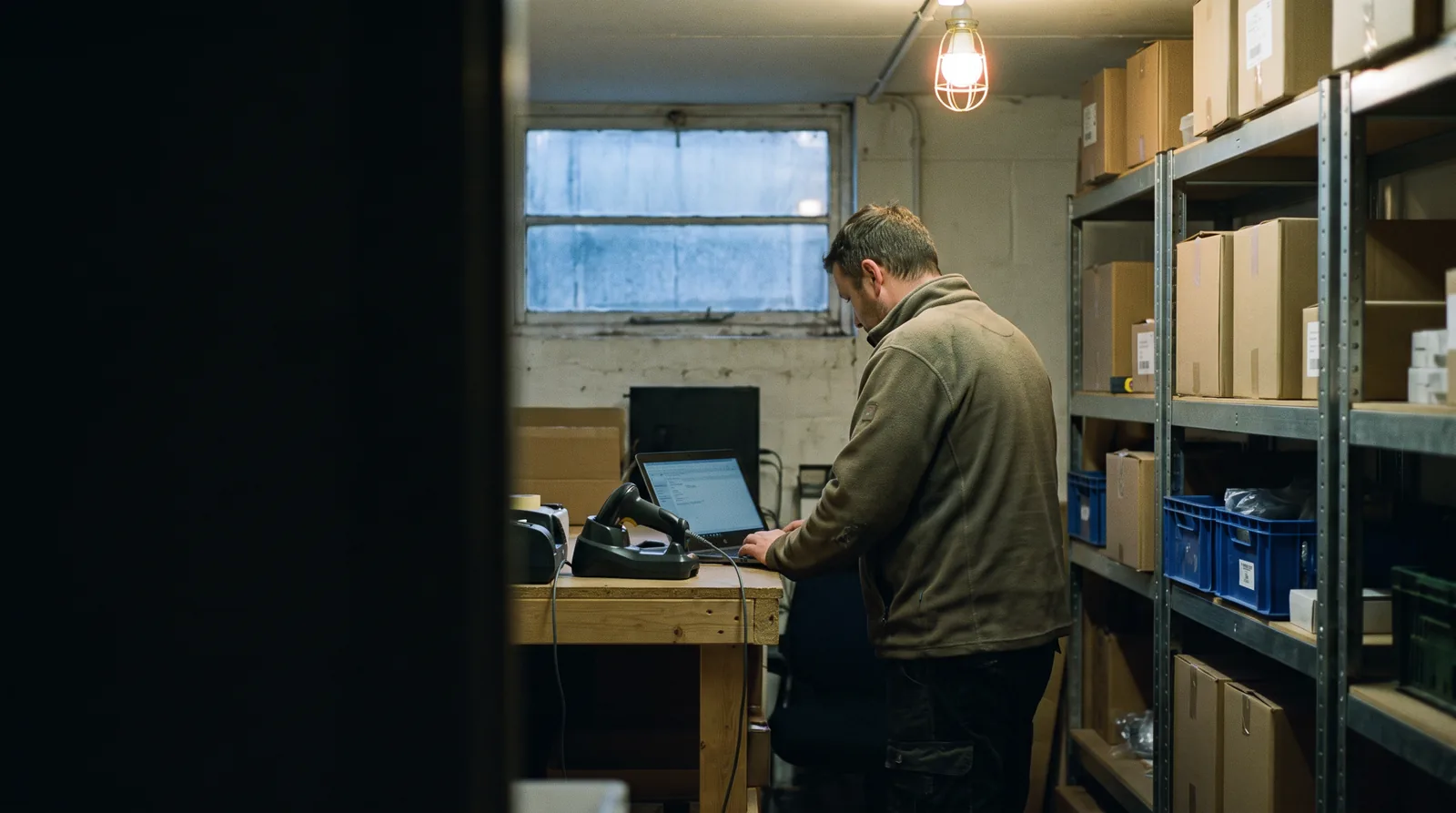
A stockroom mezzanine office at night: a man working at a laptop beside steel racking, a barcode scanner sitting in its charging dock on the desk.
Service 01 Services / Bespoke software

Software built around the way you actually work

Stock that never matches the count. Deliveries that vanish between two systems. A quoting process held together by one person’s spreadsheet and their memory. We diagnose the operational problem first, then build the system that removes it — no more, and nothing you cannot own outright.

What we build, in plain terms — and what we would talk you out of

■ 01.0 Stock control on the floor — the count, the location and the movement in one place Stock · Logistics · Bookings · Quoting · CRM
  • RegisteredLondon-based, registered in England and Wales
  • DeliverySenior-led — the people you brief do the work
  • DataUK GDPR and data protection by design
  • AccessibilityWCAG 2.2 AA as standard, not an extra
  • PricingA written scope before any quote
  • ContactDirect with the team, no account layer
01 The problemDiagnosis before build

Diagnosis first

Most of the cost is already being paid.

We do not quote until we understand what is actually going wrong. The first conversation is free, and it ends with a clear recommendation and a realistic figure — not a sales follow-up.

By the time anyone calls a developer, the process has been failing quietly for years.

The cost is never a missing feature. It is the hours spent re-typing the same figures into three places, the stock write-offs nobody can account for, and the fact that one person has quietly become the system.

The symptoms are consistent. Two systems that both hold customer records and disagree. A spreadsheet that started as a stopgap and now runs a department. Reporting that takes three days to assemble and is out of date by the time it lands. Off-the-shelf software that fits eighty per cent of the job, with the remaining twenty per cent absorbed by staff doing manual work around it.

None of that is a software problem yet. It becomes one only when we have established where the process actually breaks, who depends on the workaround, and what a fix is worth in hours and error rate. Sometimes the right answer is a change in process, a tightening of your existing tools, or a system you already licence configured properly. We tell you that, because a fix that holds is worth more to both of us than a build that does not.

02 What we buildScope, in plain terms

The work itself

Systems that carry real operational weight.

Everything is built bespoke to your process, on standard, well-documented technology. You own the source code and the documentation at handover, and another developer can pick the work up from it.

01

Stock, inventory & asset control

Live stock levels across locations, goods in and goods out, batch and serial tracking, minimum levels and reorder alerts, stock takes that reconcile rather than argue, and write-offs with a reason attached. Barcode and QR scanning on ordinary devices where it saves time on the floor.

  • Multi-location and multi-bin stock
  • Barcode and QR scanning
  • Reorder points and low-stock alerts
  • Stock takes, adjustments and audit trail
  • Supplier and purchase-order records
  • Asset registers, PAT and service dates
02

Logistics, jobs & scheduling

Job and delivery tracking from booking to sign-off, driver and engineer allocation, route and round planning, proof of delivery with photographs and signatures, and a status every member of staff and customer can see without a phone call.

  • Job, round and delivery scheduling
  • Allocation to teams, drivers and engineers
  • Proof of delivery and site photographs
  • Exceptions, failed calls and redeliveries
  • Vehicle, plant and equipment records
  • Customer-facing status without a phone call
03

Bookings, quoting & pricing

Bookings that respect real capacity and real staff availability, quotes generated from your own price rules rather than typed by hand, variations tracked against the original figure, and approvals recorded so nobody has to remember who said yes.

  • Room, resource, session and appointment booking
  • Capacity, staffing and clash prevention
  • Rule-based quoting and estimating
  • Variations, approvals and margin visibility
  • Deposits, invoicing and payment status
  • Confirmations and reminders
04

CRM, records & case management

One record per customer, member, client or young person, with contact history, documents, consents and outcomes attached. Permissions that reflect who should genuinely see what, and reporting that answers your funder’s question rather than a generic dashboard’s.

  • Contact, member and client records
  • Case notes, referrals and outcomes
  • Consent, retention and access controls
  • Pipelines, renewals and follow-ups
  • Funder, board and statutory reporting
  • Export in full, whenever you want it
05

Internal tools & process automation

The unglamorous work that pays for itself fastest: forms that replace paper, checks that stop bad data at entry, documents generated instead of assembled by hand, and the nightly routine that reconciles two systems so nobody does it manually on a Monday.

  • Forms, checklists and inspections
  • Validation that prevents bad data
  • Document and certificate generation
  • Approval chains and sign-off
  • Scheduled routines and reconciliation
  • Staff dashboards and exception lists
06

Integration & data migration

Connecting the systems you are keeping — accounting, payroll, e-commerce, payments, Microsoft — so a figure entered once appears everywhere it is needed. Historical data moved across, cleaned, checked line by line and signed off before anything is switched off.

  • APIs and integration with existing systems
  • Accounting, payments and e-commerce links
  • Migration from spreadsheets and legacy software
  • Data cleansing and de-duplication
  • Reconciliation reports before go-live
  • Parallel running where the risk warrants it
03 How it runsFive stages, five decisions

Stage by stage

You always know what happens next.

Every stage ends with something written and a decision that belongs to you. Nothing proceeds on an assumption we have not put in front of you.

  1. 01DiagnoseWe sit with the people doing the work and follow the process end to end, including the workarounds nobody documents. You get a written statement of the problem and its cost before anyone talks about software.
  2. 02ScopeA written scope: what will be built, what will not, the sequence, the dependencies on you, and a fixed price or stated day rate. Nothing is charged that is not in that document.
  3. 03Build in stagesWorking software in front of you at intervals, not a reveal at the end. Each stage ends with something you can use and a decision that belongs to you.
  4. 04Test with real dataYour data, your edge cases, your busiest day. We test what happens when the scanner fails, the connection drops, and someone enters the wrong figure — because they will.
  5. 05Launch & hand overMigration, training for the staff who will use it daily, and handover of source code, documentation and accounts. Support is available separately, never as a lock-in.

The full seven-stage delivery method, with the deliverable at each stage

04 What you getIn writing, and yours

Ownership

Yours to keep, and to take elsewhere.

Everything we make is handed over in full — the files, the code, the accounts, the documentation. Most clients stay with us because the working relationship earns it, not because anything is held back.

Written scopeThe problem, the build, the exclusions, the sequence and the price — agreed before work starts.
Source code & filesYours at handover, in a repository you control, with full history and no conditions attached.
DocumentationHow it is built, how it is deployed, how it is maintained — written so another developer can take over.
DataExportable in a standard format at any time, for as long as you run the system.
Hosting & accountsIn your organisation’s name wherever possible, with the credentials handed to you.
Delivery methodSeven named stages, each with a deliverable and a decision point.Read it
05 Straight answersCost · Ownership · Risk

Before you email

The questions we get asked most.

Answered plainly, so you can rule us in or out without a meeting. If the answer you need is not here, ask — we will give you the same straight answer by email.

Q1 Is bespoke software really cheaper than an off-the-shelf package?

Sometimes, and sometimes not — which is why we compare honestly before quoting. A package with a good fit and a sensible licence cost usually wins. Bespoke wins when your process is genuinely the thing that makes you money, when the package fit is poor enough that staff work around it, or when per-seat licensing has grown faster than your headcount. If a package fits, we will tell you which one and stop there.

Q2 We already have systems we cannot replace. Does that rule this out?

No, and it is the normal situation. Accounting, payroll and statutory systems usually stay exactly where they are. The work is often to connect them so a figure entered once stops being re-typed in three places.

Q3 How much of our time will this take?

The scope names the specific decisions and access we need from you and when. Discovery is the heaviest part — a few sessions with the people who do the work. After that we ask for reviews at the end of each stage rather than continuous involvement.

Q4 What happens if we want to change our mind halfway through?

Change is expected. A change to agreed scope is priced and recorded in writing before it is built, so the figure you were given does not quietly move. If a change makes something earlier redundant, we say that too.

Q5 Who supports it once you have finished?

We do — most clients take a support arrangement with a named contact and a stated response time, so there is always someone who knows the system when something needs fixing or changing. Your own team can run it too: the documentation is written so they can, and in practice the two work well side by side. It is your software either way, so the arrangement continues because it is useful to you.

Q6 Do you take on rescue work on a system somebody else built?

Yes, and we will give you a straight assessment first: whether it is worth repairing, extending or replacing. Occasionally the answer is that the existing build is sound and needs a better handover, not a rewrite.

07Work with usWe reply within three working days

Bring us the problem.
We’ll build the solution.

Send a short outline of the work, your timeline and a budget range if you have one. We will come back with a written scope, an honest view of the risks, and a price.

hello@youngfuturesdigital.co.uk