Young Futures Digital
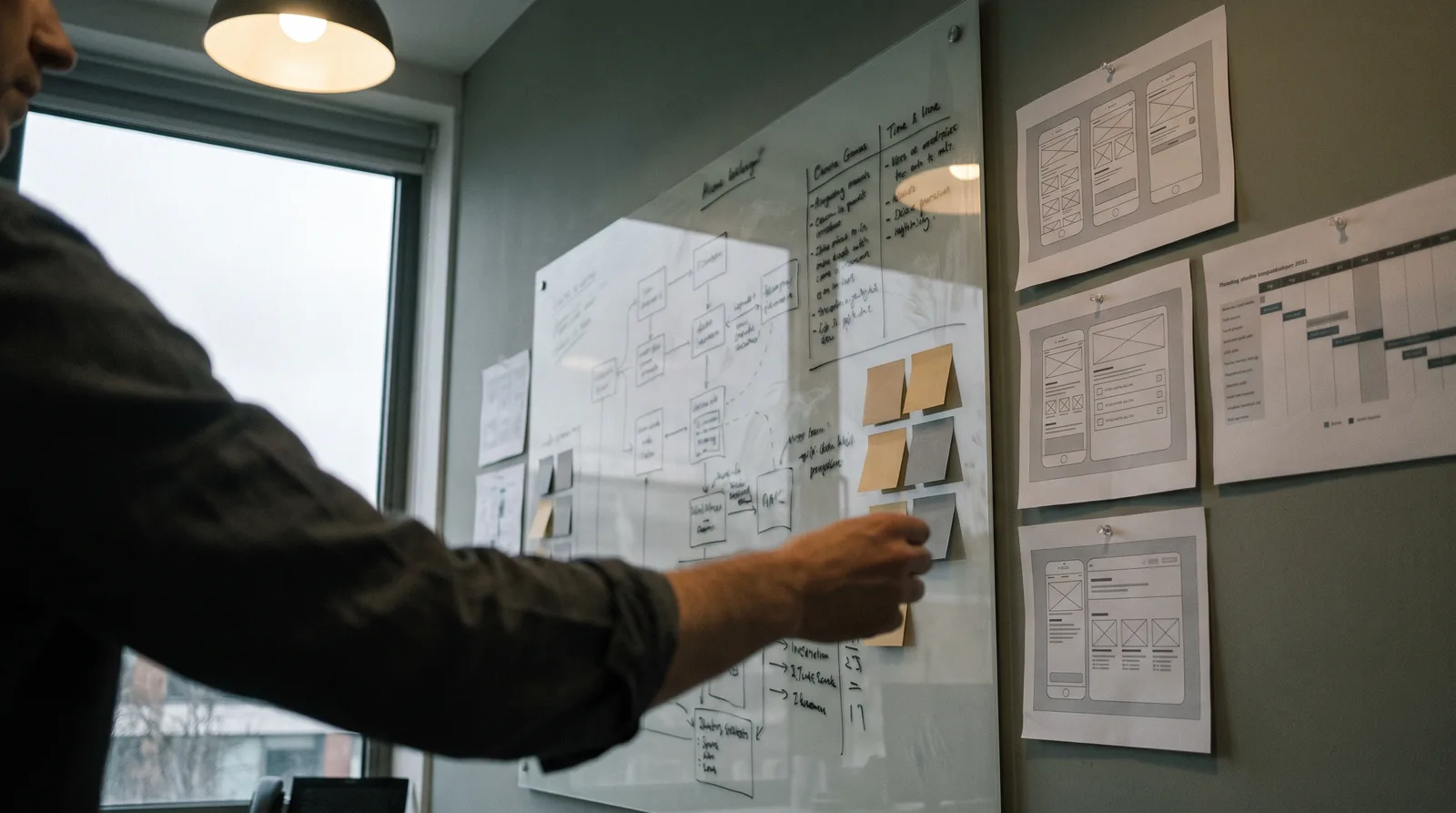
A project scoping wall in a studio: a process diagram drawn on a glass whiteboard beside pinned wireframe printouts and a printed timeline, with a hand reaching in to move a note.
Page 04 Delivery method

A method you can hold us to

Seven named stages, a written deliverable at each one, and a decision that belongs to you before the next stage starts. This is how work runs at Young Futures Digital — the same way on a two-day piece of design as on a year-long build.

How to engage us, lead times and who to contact

■ 04.0 Scoping board — the work agreed in writing before anything is built 07 stages · 07 deliverables
  • RegisteredLondon-based, registered in England and Wales
  • DeliverySenior-led — the people you brief do the work
  • DataUK GDPR and data protection by design
  • AccessibilityWCAG 2.2 AA as standard, not an extra
  • PricingA written scope before any quote
  • ContactDirect with the team, no account layer
01 MethodDiscovery to handover, and after

Most digital projects fail quietly, in the gap between what was agreed and what was understood.

We close that gap with paperwork rather than optimism. Every stage below ends with something written that you can circulate, challenge and sign off: a discovery note, a scope, a design pack, a test report, a handover pack. Nothing moves forward on the strength of a good meeting.

The method scales down as well as up. A short training commission uses the same seven stages compressed into days rather than months. A safeguarding-sensitive build uses them in full, with a data protection impact assessment running alongside from discovery onwards.

We are an independent London studio, so the people who scope the work are the people who deliver it. There is no account layer between you and the team, and no handover from a sales function to a delivery function part-way through.

02 The seven stages01–07

Seven stages, seven things you can read

Each stage has an owner, a deliverable and a decision point. You can stop, change direction or take the work elsewhere at any of them, and you will have the documentation to do it.

01

Discovery

We start by understanding the problem rather than the request. That means reading what you already have — strategies, needs assessments, incident data, previous evaluations — and talking to the people who will use, run and be affected by the thing being built.

What you get
  • A written discovery note: problem, users, constraints
  • A map of existing systems, data and dependencies
  • An initial risk and safeguarding register
  • A first view on whether the idea should proceed at all
Decision point

You decide whether the problem is worth solving in the form proposed. We will tell you if we think it is not.

02

Scoping

Scope is written before any quote is issued. It states deliverables, assumptions, dependencies, timeline, acceptance criteria and, just as importantly, what is out of scope.

What you get
  • A written scope document
  • A fixed price, or a stated day rate with the basis of the estimate shown
  • A delivery timeline with named milestones
  • Draft data protection and processing arrangements
Decision point

You approve the scope and price in writing. Work does not start before that.

03

Design

Design covers structure, content and interface together. We prototype early and put the prototype in front of real users — including young people where the work is for them — rather than reviewing it only with the commissioning team.

What you get
  • Information architecture and content structure
  • Interactive prototypes for the main journeys
  • Accessibility approach documented against WCAG 2.2 AA
  • Findings from user and co-design sessions
Decision point

You sign off the design direction before build effort is committed.

04

Build

Delivery runs in short cycles with a working version you can open. Progress is visible continuously rather than revealed at the end, and the decision log is kept as we go.

What you get
  • A working environment you can access throughout
  • Regular written progress notes against the milestones
  • A maintained decision and change log
  • Source code held in version control from day one
Decision point

You review each cycle and confirm priorities for the next one.

05

Test

Testing is functional, accessible and adversarial. We test what the thing does, whether people who rely on assistive technology or an old handset can use it, and how it behaves when someone tries to misuse it.

What you get
  • A test report covering functionality and defects
  • Accessibility testing against WCAG 2.2 AA, including keyboard and screen-reader passes
  • Performance testing on low-bandwidth connections and older devices
  • Security testing appropriate to the sensitivity of the data
  • User acceptance testing run with your team
Decision point

You confirm acceptance against the criteria agreed at scoping.

06

Handover

Handover is designed so that you are never dependent on us. Everything needed to run, change or replace the work is transferred and documented at the end of the project, not negotiated afterwards.

What you get
  • Source code, design files and assets transferred to you
  • Technical and editorial documentation
  • Administrator training for your team
  • A record of data locations, retention periods and deletion routes
Decision point

You accept handover. From this point you can run the work without us.

07

Support

Support is a separate, optional agreement with its own scope and price. It is never a condition of the work being usable, and it is never a lock-in.

What you get
  • An agreed support scope with response targets in writing
  • Security patching and dependency updates
  • A named point of contact and a written record of issues
  • The option to end support without losing access to anything
Decision point

You choose whether to take support, at what level, and for how long.

03 Running the workDelivery controls

Governance, risk and change control

The unglamorous part, written down. These are the controls that apply to every engagement, whatever its size.

Named accountability
One named lead is accountable for the project end to end, and one named contact on your side is agreed at scoping. Both are recorded in the scope document.
Reporting rhythm
A short written progress note at an agreed interval — usually fortnightly — covering what was done, what is next, what has changed and what we need from you. Meetings are in addition to the written record, never instead of it.
Change control
Any change to scope, price or timeline is written down, priced and approved before it is acted on. Small changes are logged; anything affecting cost or delivery date requires your written agreement.
Risk management
A risk register is opened at discovery and reviewed at every progress point. Each risk has an owner, an impact, a likelihood and a mitigation. Safeguarding and data protection risks are tracked in the same register rather than a separate one.
Quality assurance
Code review before anything is merged. Accessibility checks during design and build, not only at test. Content reviewed for plain English. A defined definition of done for every milestone.
Issue escalation
A documented escalation route with response expectations, agreed at scoping. Anything with a safeguarding dimension is escalated immediately and in line with your setting’s own policy.
Acceptance
Acceptance criteria are written at scoping, not invented at the end. Sign-off is against those criteria.
Records
Decisions, changes, risks and approvals are kept in writing for the life of the contract, and you hold a copy throughout.
A plain office desk at night lit by a single lamp: a closed laptop, a clipped stack of printed documents, a pen and a staff lanyard.
The written record — scope, change log, risk register, test report21:10 · City Road
04 Contract and valueContract management

What the buyer actually gets

Transparent pricing, defined support, and an exit that costs you nothing. Value for money is easier to evidence when there is nothing hidden in the structure.

Written scope first
We do not quote against a conversation. A written scope comes first, and the quote is priced against it, so you can see exactly what the money buys.
Pricing
Fixed price where the scope is stable; a stated day rate where it is not. Both are quoted in writing with the basis of the estimate shown. We do not charge for scoping conversations before a project begins.
No account layer
You deal directly with the people doing the work. There is no account manager margin and no relationship team to go through.
Support and response
Where support is agreed, response targets are written into the contract. As standard we offer a same-working-day response target for anything affecting safety, safeguarding or availability, and a next-working-day target for standard issues. Tighter targets can be agreed and priced.
Maintenance
Security patching, dependency updates and small changes can be bundled into a support agreement at a stated monthly cost, or bought as needed. Either way the cost is known in advance.
Exit and continuity
Everything needed to run the work without us is handed over at the end of delivery. If a support agreement ends, nothing is switched off and nothing is withheld.
Open standards
We build on open, widely supported technology and standard data formats so that another supplier can pick the work up. We avoid proprietary lock-in as a matter of policy.
Source code and IP
Intellectual property and licensing are agreed in writing at contract stage. Where you have paid for bespoke work, our default position is that the source code and design files are transferred to you.
Social value
Social value commitments relevant to your contract are written into the scope and reported against during delivery. Our standing commitments are set out on the standards and social value page.
05 Working with usProcurement

How to engage us, and how long it takes

Three questions a commissioner asks before anything else. Answered plainly, with no obligation on either side.

01

How to engage us

Direct award, written quotation, or your own competitive process — whichever your standing orders require. Most engagements run through direct award below threshold or written quotation, and we are set up to respond to a formal tender where you need one. Purchase orders, supplier onboarding, processor terms and DPIA support are handled as part of getting started.
02

Lead times

Typical timescales, confirmed in writing once we have your brief: an initial conversation within a week of your first email; a written scope within one to two weeks of a scoping session; training dates typically bookable four to six weeks ahead; build projects starting on an agreed date once scope and contract are signed. We commit to real dates rather than optimistic ones, and we agree them with you in writing before work starts.
03

Who to contact

There is one route in and it reaches the people who do the work: hello@youngfuturesdigital.co.uk. Enquiries are answered by the team, not by a mailbox that routes to a sales function. We reply within three working days. A named project lead and a named day-to-day contact are agreed and recorded at scoping.

What to include in your first message Standards, governance and social value

06Work with usWe reply within three working days

Send us the problem, not a specification

You do not need a finished brief. A paragraph about what you are trying to achieve and roughly when is enough to start a scoping conversation, and there is no cost or obligation attached to it.

hello@youngfuturesdigital.co.uk